Built-In vs External Grinder: Worth the Upgrade?
Compare built-in vs standalone espresso grinders. Learn when to upgrade from your Breville's integrated grinder to an external option for better consistency and control.
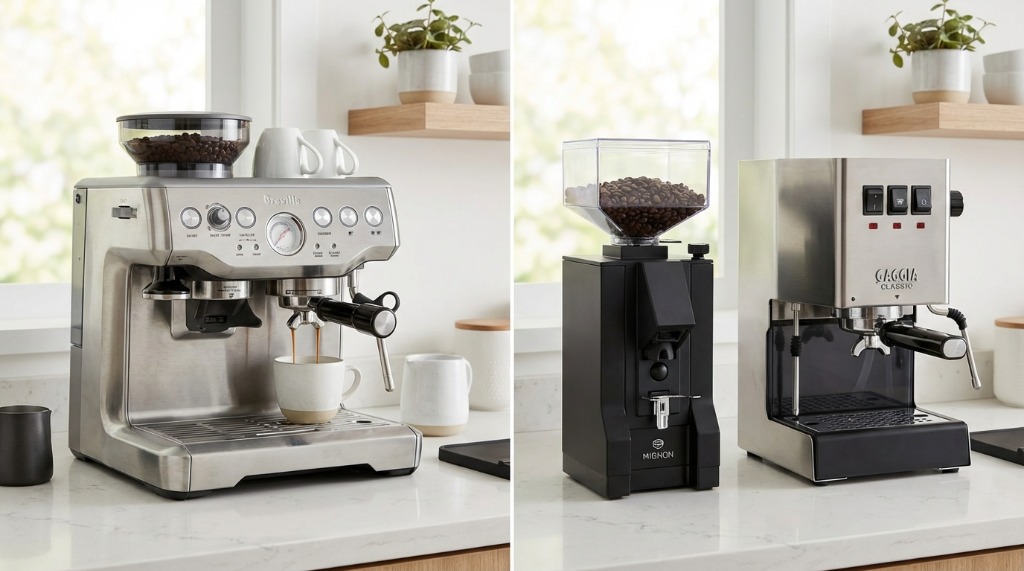
When I bought my Breville Barista Express, the built-in grinder felt like a bonus feature. One machine, everything included—what’s not to love?
Then I started chasing consistency. And I realized the grinder was holding me back.
This article isn’t about convincing you to upgrade. It’s about helping you understand when an external grinder makes sense—and when the built-in option is genuinely the right choice.
Quick Definition (So We’re Comparing the Same Thing)
What “Built-In Grinder” Usually Means
A built-in grinder is integrated into your espresso machine. The Breville Barista Express, Barista Pro, and Barista Touch all have them. You load beans in the hopper, press a button, and grounds land directly in the portafilter.
Primary appeal: Compact, convenient, fewer steps.
The experience feels seamless because grinding and brewing happen in one unit. There’s no transfer of grounds, no separate machine to manage.
What “External/Standalone Grinder” Means
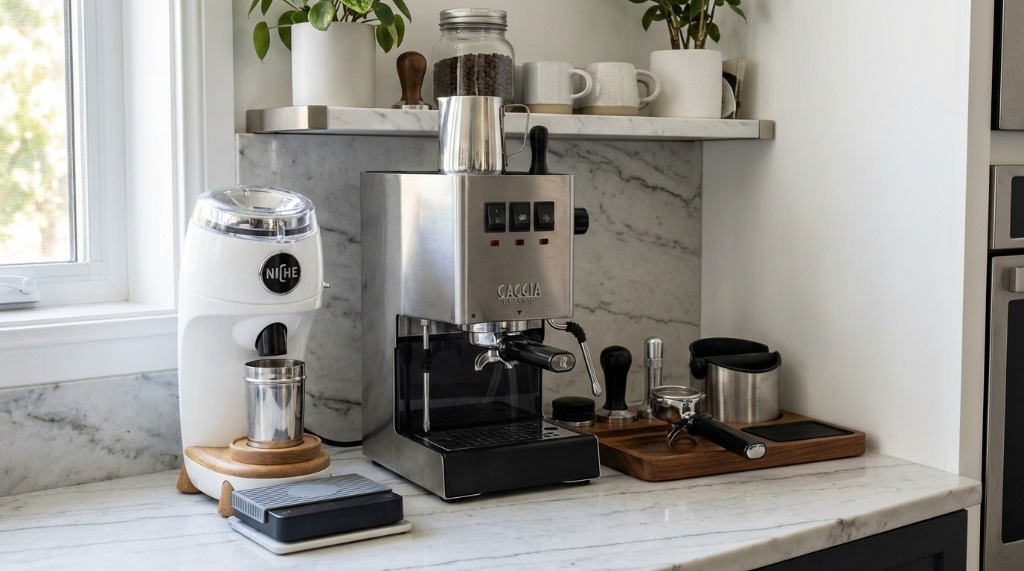 An external grinder setup, like this Niche Zero paired with a Gaggia Classic, provides a dedicated machine for grinding, allowing for greater precision and an easier upgrade path.
An external grinder is a separate machine—dedicated to one job: grinding. Examples range from the Breville Smart Grinder Pro ($200) to the Niche Zero ($700+) to commercial-grade flat burr grinders.
Primary appeal: Flexibility and upgradability.
You can pair any grinder with any espresso machine. If one breaks, the other still works. If you want better grind quality, you upgrade just the grinder.
The Key Idea: Consistency Is Driven by Grinding Precision
Here’s what many beginners miss: the grinder affects shot quality more than the espresso machine itself.
A $300 machine with a $500 grinder often produces better espresso than a $800 machine with a $100 grinder. The narrow extraction window of espresso demands precision that only capable grinders can deliver.
So when we ask “is upgrading worth it?”—we’re really asking: “Is my current grinder limiting my results?”
Why People Choose Built-In Grinders
Built-in grinders aren’t a compromise—they’re a conscious choice. Here’s why:
Convenience and Streamlined Routine
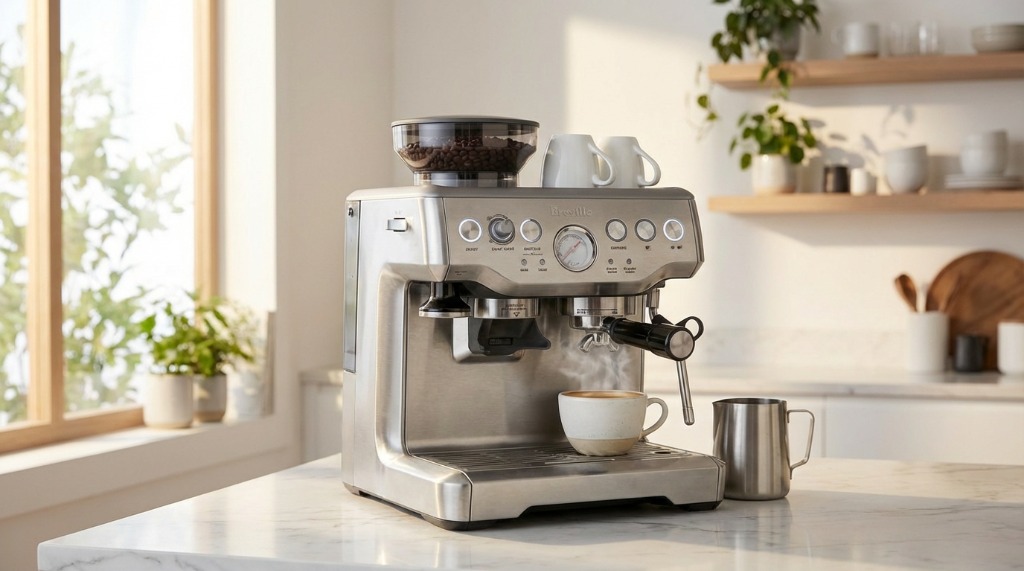 The Breville Barista Express offers a compact, all-in-one solution that streamlines the morning coffee routine by integrating the grinder and espresso machine into one footprint.
One machine. One power cord. One cleaning routine.
With a built-in grinder, my morning workflow is:
- Bean hopper → grind → brew → drink
No transferring grounds between devices. No extra button presses. The “friction” from bed to caffeine is minimal.
For exhausted mornings, this matters.
Space-Saving Footprint
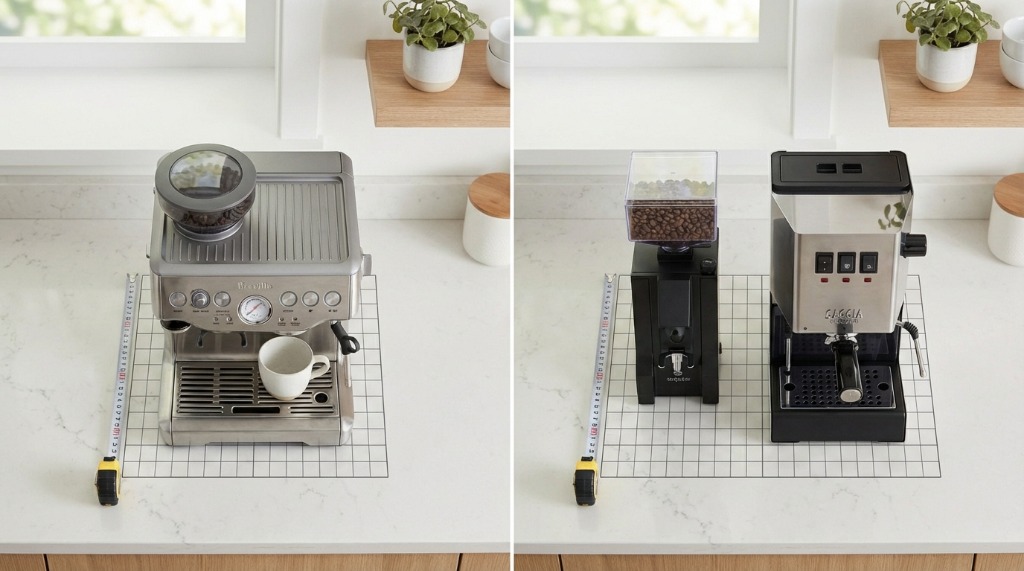 A top-down visualization of the counter space requirements. Integrated machines like the Barista Express (left) offer a significantly smaller footprint compared to a separate machine and grinder setup (right).
My countertop is 60cm deep. A Barista Express takes ~35cm. Adding a standalone grinder means another 15-20cm of depth.
All-in-one machines genuinely save space. If your kitchen is tight, a built-in grinder might be the practical choice—not a limitation.
Freshness vs Pre-Ground Coffee
The biggest upgrade most people make is moving from pre-ground coffee to grinding fresh.
Built-in grinders accomplish this. You’re grinding beans minutes (or seconds) before extraction. That alone transforms espresso quality compared to week-old pre-ground from a bag.
If you’re coming from pre-ground, a built-in grinder is a massive step up. Don’t underestimate it.
Perceived Value and Compatibility
For beginners, built-in grinders reduce risk:
- No worrying whether a standalone grinder can actually grind fine enough for espresso
- No compatibility concerns (will the grinder fit my workflow?)
- No decision fatigue from researching separate components
The Breville Barista Express is popular precisely because it removes these questions. It just works.
Less Mess and a Tidier Station
Grounds stay contained inside the unit. The portafilter catches everything. No transfer spills, no static-charged grounds flying onto the counter.
For minimalists who hate coffee dust everywhere, this is a real benefit.
The Trade-Offs of Built-In Grinders (What You Give Up)
Now the honest part.
Limited Grind Adjustment and Calibration Depth
Most built-in grinders have fewer adjustment steps than standalone alternatives.
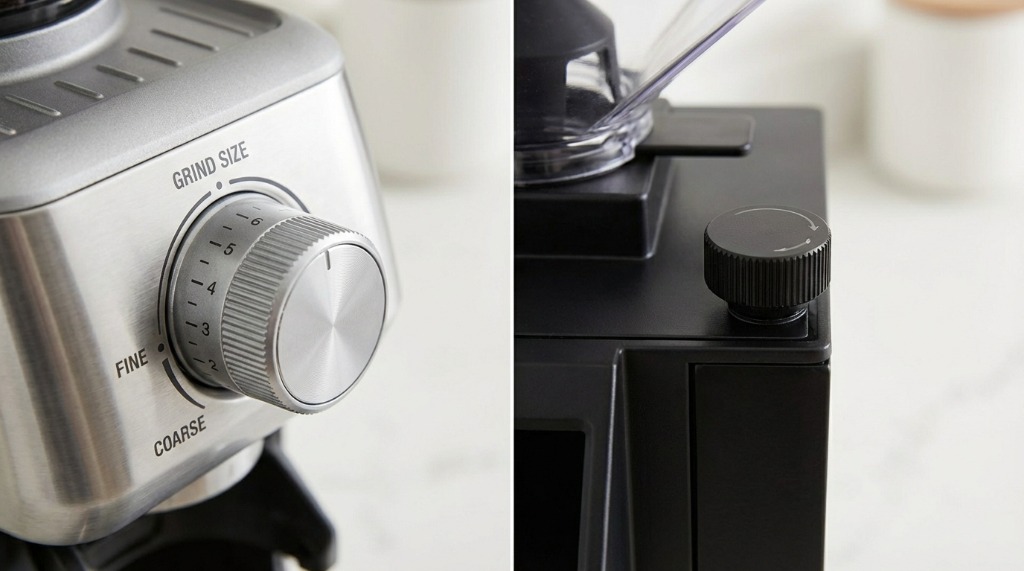 A comparison between the stepped dial of a Breville Barista Express (left) and the stepless micro-adjustment of a standalone grinder (right), which allows for much finer control over extraction.
The Barista Express has about 16 numbered settings plus internal calibration. The Niche Zero has infinitely variable adjustment. That’s a meaningful difference when you’re trying to dial in a light roast that needs micro-adjustments.
The symptom: You can’t find a setting between “too fast” and “too slow.” You’re jumping in steps that are too large.
Upgrade Path Is Constrained
What happens when the grinder is the limiting factor—but it’s physically part of your machine?
You can’t just upgrade the grinder. You’d have to:
- Buy a standalone grinder anyway (making the built-in redundant)
- Or replace the entire machine
This is the “upgrade trap.” You eventually pay for a grinder twice—once built-in, once standalone.
Maintenance and Service Complexity
Built-in grinders are integrated into tight spaces. Accessing the burrs often requires partial disassembly. Cleaning is possible but fiddlier than a standalone where you can just pop off the hopper and reach the burr chamber directly.
For daily cleaning, this isn’t a big deal. For deep maintenance, it adds friction.
If One Part Breaks, Everything Is Down
If the grinder motor fails on a Barista Express, the whole machine goes to service. You can’t brew while waiting for repairs.
With separate units, a broken grinder means you buy pre-ground for a week while ordering a replacement. The espresso machine keeps working.
Risk diversification isn’t sexy, but it’s practical.
Noise, Size, and Handling
Built-in grinders are still noisy (65-70 dB for Breville). And while space-saving, the all-in-one unit is heavy and awkward to move for cleaning.
The Smart Grinder Pro alone weighs 2.5kg. The Barista Express weighs 10kg. Moving the combined unit for counter cleaning is annoying.
Why Upgrading to an External Grinder Can Be Worth It
If you’re hitting the ceiling of your built-in grinder, here’s what upgrading offers:
Better Control for Espresso Dial-In
Espresso extraction happens in a narrow window. A few seconds too fast or slow, and taste changes dramatically.
Quality standalone grinders offer:
- Stepless adjustment (infinite settings, not fixed steps)
- Larger burrs (more consistent particle distribution)
- Lower retention (fresher doses)
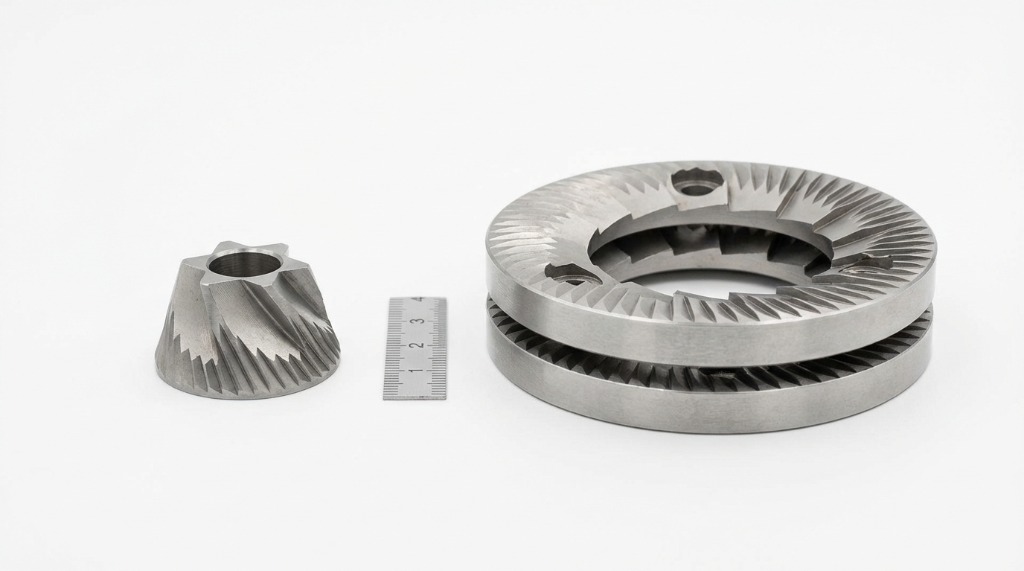 Comparison between small conical burrs typically found in built-in grinders (left) and larger flat burrs from a standalone grinder (right). Larger burrs provide more grinding surface area and better particle uniformity.
This translates to easier dial-in and more repeatable shots. When you find the sweet spot, you can stay there.
Easier Incremental Upgrades Over Time
The sensible upgrade path:
- Start with entry-level machine + decent grinder
- Upgrade grinder when it becomes limiting
- Upgrade machine when ready for temperature stability or pressure profiling
With separate components, you can upgrade one piece at a time as budget allows. You’re not forced into total replacement.
Maintenance Is Often Simpler and Faster
Standalone grinders are designed for easy burr access:
- Remove hopper
- Twist off upper burr
- Brush out, wipe, reassemble
On my Eureka grinder, deep cleaning takes 5 minutes. On the Barista Express built-in, it takes 15 and requires reading the manual.
Easier maintenance = more consistent cleaning = more consistent coffee.
More Flexibility Across Brew Methods
A quality grinder works for:
- Espresso (fine)
- Moka pot (medium-fine)
- Pour over (medium)
- French press (coarse)
The Breville built-in grinders handle espresso well but struggle at coarser settings. If you want to explore other brew methods, a versatile standalone grinder serves you better.
Matching Beans to Grinder Performance
Different beans have different densities. Light roasts are harder and require more burr power. Dark roasts are softer and grind faster.
Quality grinders handle this variation more gracefully. Built-in grinders often have fixed motor speeds that work for medium roasts but struggle with light roast specialty coffee.
If you’re exploring third-wave roasters and light roast espresso, a capable standalone grinder helps extract those complex flavours.
Decision Framework: Who Should Upgrade (And Who Shouldn’t)
Stay With Built-In If You Prioritise Speed + Simplicity
The built-in grinder is right for you if:
- You value convenience over optimization
- You drink medium-dark roasts primarily
- Your shots taste good enough to you
- You don’t want another appliance
No shame in this. Good espresso is espresso you enjoy drinking. If the built-in gets you there, it’s doing its job.
Upgrade to External If You Chase Repeatability and Want Room to Grow
Consider upgrading if:
- You’re constantly frustrated by inconsistent shots
- You can’t find the right grind setting (too coarse/too fine, nothing in between)
- You want to explore light roasts or specialty coffee
- You plan to upgrade your espresso machine eventually
The grinder upgrade often has more impact than a machine upgrade. If your budget is limited, prioritise grinder over machine.
Ask These Practical Questions Before You Buy
Before purchasing a standalone grinder:
- Do I have counter space? Measure first.
- How much time do I have in the morning? Separate grinder adds 30 seconds.
- Do I make back-to-back drinks? Retention and workflow matter more.
- Am I willing to maintain two machines? Cleaning doubles.
- What’s my budget—now and in 2 years? Think upgrade path.
Be honest. A $600 grinder collecting dust because you hate the extra steps is worse than a built-in you actually use.
A Simple Upgrade Roadmap
If you decide to upgrade, here’s a sensible sequence:
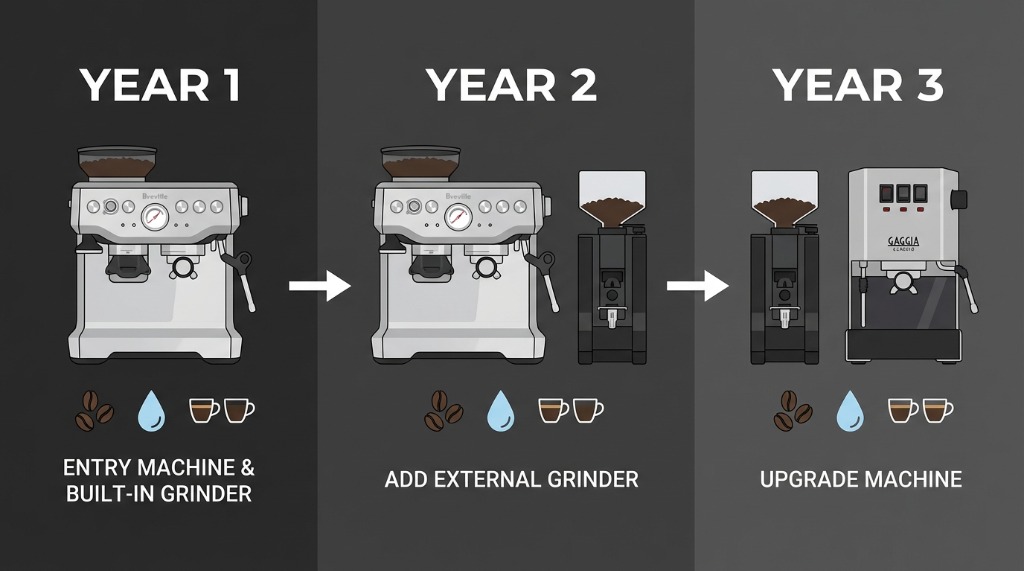 A visual roadmap for upgrading your espresso setup over three years, transitioning from an all-in-one unit to dedicated components for maximum quality.
Year 1: Entry machine with built-in grinder (Barista Express)
- Learn basics, develop palate, understand your preferences
Year 2: Add standalone grinder (Eureka Mignon, Breville Smart Grinder Pro)
- Keep using built-in for guests/backup
- Primary workflow moves to external grinder
Year 3+: Upgrade machine (Breville Dual Boiler, Gaggia Classic Pro, Profitec)
- Keep your standalone grinder (it’s already good)
- New machine offers temperature stability, steam power, or profiling
This approach spreads cost over time and ensures each upgrade is justified by your actual needs.
Conclusion
Built-in grinders are convenient, space-saving, and genuinely good enough for many home baristas. Don’t feel pressured to upgrade if your coffee tastes great.
But if you’re chasing consistency, exploring specialty coffee, or planning a long-term setup—upgrading to an external grinder is usually the highest-impact change you can make.
The grinder is the bottleneck. Address it, and everything else improves.
My recommendation: Start where you are. Upgrade the grinder first if you hit a ceiling. Then upgrade the machine when you’re ready. One step at a time, each investment pays off.

Mikael
Home espresso enthusiast and Breville specialist. Helping you master the art of coffee brewing from your own kitchen.
Learn more about me →