Espresso Extraction Time: The 25-30 Second Rule
Master espresso extraction timing on your Breville. Learn the science behind 25-30 seconds, how to measure, troubleshoot fast/slow shots, and dial in perfectly.
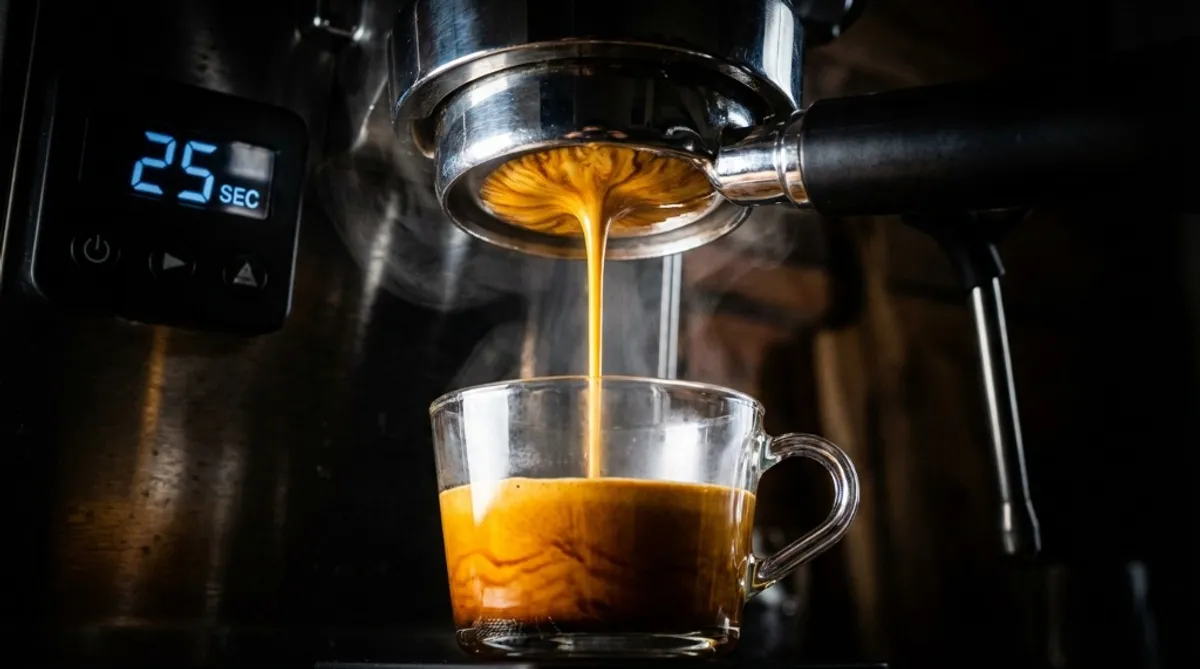
“Aim for 25-30 seconds.” You’ve heard this advice probably a hundred times. But why those specific numbers? What happens at 22 seconds versus 35 seconds? And how do you actually hit that target consistently?
After pulling thousands of shots on my Breville, I’ve developed a real appreciation for extraction timing. It’s not just a number to chase—it’s a window into what’s happening inside your coffee puck. Here’s the science and the practice.
Why 25-30 Seconds? The Science
What Happens During Extraction
When hot water passes through your coffee puck, it dissolves compounds in a specific sequence:
| Time | What’s Extracting | Flavor Contribution |
|---|---|---|
| 0-10 sec | Acids, fruity compounds | Brightness, acidity |
| 10-20 sec | Sugars, oils, aromatics | Sweetness, body |
| 20-30 sec | Deeper sugars, caramels | Complexity, roundness |
| 30+ sec | Bitter compounds, tannins | Bitterness, astringency |
The 25-30 second window captures the best of each phase while stopping before bitter compounds dominate.
The Math Behind the Rule
SCA (Specialty Coffee Association) guidelines suggest:
- Extraction yield: 18-22% of coffee mass dissolved
- TDS (Total Dissolved Solids): 8-12%
- Brew ratio: 1:2 (18g coffee → 36g espresso)
At standard 9-bar pressure with proper grind, hitting these targets naturally takes around 25-30 seconds for a double shot. Not arbitrary—it’s the time needed for balanced extraction.
Why Not Faster or Slower?
Under 20 seconds (too fast):
- Not enough time to extract sugars
- Result: Sour, thin, acidic—under-extracted
Over 35 seconds (too slow):
- Extracts too much, including bitter stuff
- Result: Harsh, dry, astringent—over-extracted
That sweet spot captures acids AND sugars while avoiding excessive bitterness.
How to Measure Extraction Time
What to Include
Start timer the moment you press the button, NOT when coffee first appears. Include:
- Pre-infusion time (if your machine has it)
- Time before first drips appear
- Full extraction until you stop
Some people only time from first drip—less accurate because pre-infusion affects extraction too.
Tools for Timing
Basic method:
- Smartphone stopwatch
- Start when pressing button
- Stop when you end the shot
Better method:
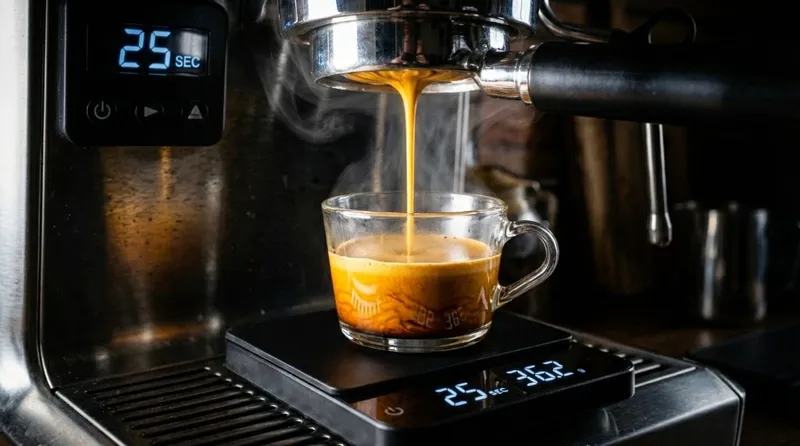
- Dedicated shot timer (sits on scale)
- Auto-starts on weight change
- More accurate, hands-free
Best method:
- Scale with built-in timer (like Acaia)
- Starts automatically
- Shows weight AND time together
I use a $30 coffee scale with timer—accurate enough for home use.
Recording Data
For each shot, note:
- Dose (grams in)
- Yield (grams out)
- Time (seconds)
- Grind setting
- Taste impression
After a few weeks, patterns emerge that guide adjustments.
Factors That Affect Extraction Time
1. Grind Size (Most Important)
Finer grind → More resistance → Slower shot Coarser grind → Less resistance → Faster shot
Typical Breville adjustment:
- Too fast? Go 1-2 steps finer (lower number)
- Too slow? Go 1-2 steps coarser (higher number)
2. Dose
More coffee → More resistance → Slower shot Less coffee → Less resistance → Faster shot
Typical adjustment:
- Too fast? Increase dose by 0.5-1g
- Too slow? Decrease dose by 0.5-1g
3. Tamp Pressure
Harder tamp → More compact puck → Slower shot Lighter tamp → Looser puck → Faster shot
But don’t over-rely on this. Tamping should stay consistent. Adjust grind before adjusting tamp.
4. Distribution
Even distribution → Even extraction → Predictable timing Uneven distribution → Channeling → Unpredictable timing
Signs of poor distribution:
- Timing varies wildly with same settings
- Spurting or uneven flow
- Both sour AND bitter in same shot
5. Coffee Freshness
Fresh beans (lots of CO2) → More resistance → Slower shot Stale beans (degassed) → Less resistance → Faster shot
Adjustment:
- Very fresh beans (3-7 days): Grind coarser
- Optimal (7-21 days): Standard grind
- Aging beans (21+ days): Grind finer
6. Water Temperature
Higher temp → Faster extraction → May need faster shot time Lower temp → Slower extraction → Can tolerate longer shot time
On Breville machines with temp control (Dual Boiler):
- Light roast: Higher temp (94-96°C)
- Dark roast: Lower temp (91-93°C)
Troubleshooting: When Timing Is Off
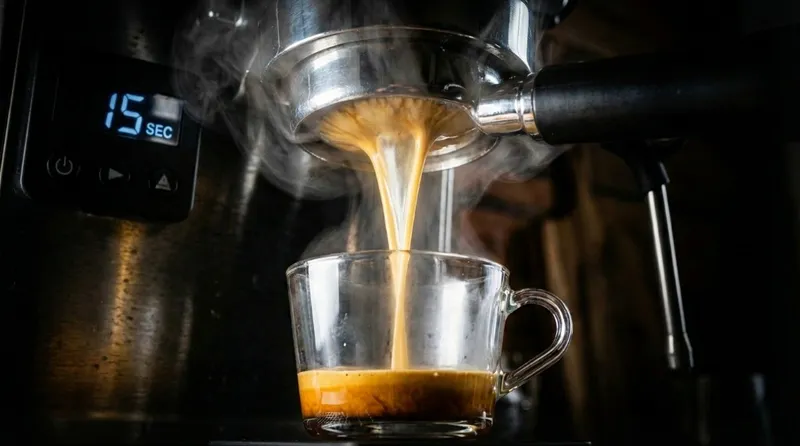
Shot Running Too Fast (Under 20 Seconds)
Symptoms:
- Gushing, watery stream
- Pale, thin crema
- Sour, acidic taste
- Gauge under-pressure
Systematic fix:
- Check dose—is it actually 18g?
- Grind finer—start with 1 step
- Tamp evenly—firm, level pressure
- Check distribution—WDT helps
If still fast after finest grind:
- Beans may be stale
- Check basket—ensure using double
- Grinder may need calibration
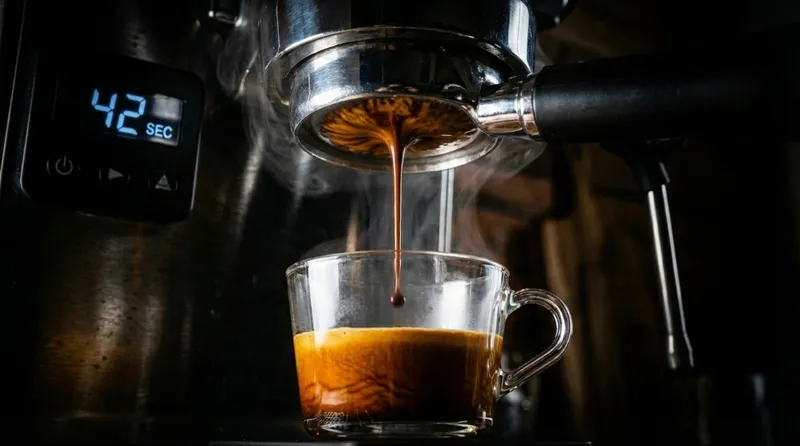
Shot Running Too Slow (Over 35 Seconds)
Symptoms:
- Slow drips or mouse-tail flow
- Dark, burnt crema
- Bitter, harsh taste
- Gauge over-pressure
Systematic fix:
- Check dose—overfilled?
- Grind coarser—start with 1 step
- Reduce dose—try 17g instead of 18g
- Tamp lighter—don’t force it
If still slow after coarser grind:
- Beans may be too light roast for your grinder
- Machine needs cleaning/descaling
- Shower screen may be clogged
Timing Is Inconsistent
Symptoms:
- Same settings, wildly different times (22 sec one shot, 32 sec next)
- Some channeling visible
- Unpredictable taste
Systematic fix:
- Distribution—must be consistent shot to shot
- Tamping—practice same pressure each time
- Purge grinder—old grounds mixing in
- Check basket—ensure no clogs
Breville-Specific Timing Tips
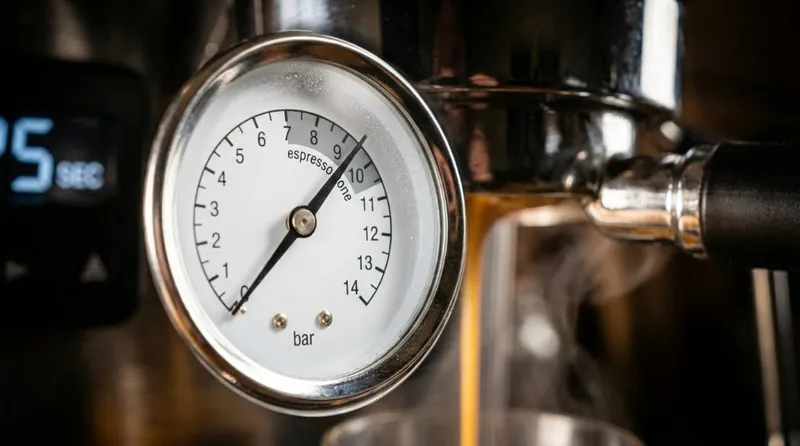
Using the Pressure Gauge
The Barista Express gauge correlates with timing:
| Gauge Reading | Shot Time Likely | Action |
|---|---|---|
| Below zone | Under 20 sec | Grind much finer |
| Left of zone | 20-25 sec | Grind slightly finer |
| In the zone | 25-30 sec | Maintain settings |
| Right of zone | 30-35 sec | Grind slightly coarser |
| Far right/max | Over 35 sec | Grind much coarser |
Gauge is useful guide, but timing + taste are the real measures.
Pre-Infusion on Breville
Most Breville machines have automatic low-pressure pre-infusion for first few seconds:
- Wets puck evenly
- Reduces channeling
- Adds time before full extraction
Account for this:
- Pre-infusion typically adds 3-5 seconds
- A 28-second shot may have 5 seconds pre-infusion + 23 seconds extraction
On Dual Boiler with adjustable pre-infusion:
- Longer (6-10 sec): Better for light roasts
- Shorter (2-4 sec): Standard for medium/dark
First Shot of the Day
First shot often runs faster because:
- Group head hasn’t fully heated
- Colder water = less extraction
My routine:
- Flush 2-3 seconds of water through empty group head
- Wait 30 seconds
- Pull first shot
This brings group head up to temp.
Beyond the Rule: When to Break It
The 25-30 second rule is a starting point, not law.
Light Roasts: Go Longer
Light roast specialty coffee often tastes better at 30-40 seconds:
- Dense beans need more time
- Acidity needs more extraction to balance
- Sweetness develops later
I regularly pull light roast Ethiopian at 35 seconds—sour at 25, perfect at 35.
Dark Roasts: Go Shorter
Dark roasts can taste bitter before 25 seconds:
- Already developed flavors
- Less material to extract
- Bitterness comes early
Many Italian roasts taste great at 20-22 seconds.
Ristretto: Short and Intense
Classic ristretto uses 1:1 ratio:
- 18g in → 18g out
- Time: 20-25 seconds
- Result: Intense, syrupy, less bitter
Lungo: Longer Pull
Lungo uses 1:3 or higher:
- 18g in → 54g out
- Time: 35-45 seconds
- Result: More volume, slightly diluted
Taste Is Final Judge
Best shot time is the one that tastes balanced to YOU.
Process:
- Start with 25-30 second target
- Taste result
- Adjust: Faster if too bitter, slower if too sour
- Repeat until delicious
Trust the clock initially, but graduate to trusting your palate.
My Extraction Time Workflow
Here’s how I dial in a new bag:
Shot 1: The Scout
- Use expected grind based on roast/origin
- Pull shot, time it
- Note time + taste, no adjustments yet
Shot 2: The Correction
- If Shot 1 was <22 sec → grind 2 steps finer
- If 22-25 sec → grind 1 step finer
- If 25-30 sec → keep setting
- If 30-35 sec → grind 1 step coarser
- If >35 sec → grind 2 steps coarser
Shot 3: The Refinement
- Fine-tune with half-step grind or ±0.5g dose
- Taste for balance, not just timing
- Usually dialed in by now
Recording:
- Note final settings
- When bag is halfway done, check if adjustment needed
- When opening same beans again, start at recorded setting
FAQ
Does pre-infusion count toward extraction time?
Yes. Start timing when you press button, not when coffee appears. Pre-infusion affects extraction and should be included.
My shots are always 23 seconds. Is that okay?
If they taste balanced (not too sour, not too bitter), 23 seconds is fine. The rule is a guideline. Taste matters.
Should I time single and double shots the same?
Yes, both target 25-30 seconds. Difference is volume (dose and yield), not extraction time.
Why do morning shots run faster than evening shots?
Machine temperature. Morning shots often have cooler group head. Flush water through before first shot.
How precise does timer need to be?
Within 1 second is fine. You’re looking for patterns, not exact science.
Is longer always more extracted?
Yes, within same grind/dose setup. But “more extracted” isn’t always better—there’s an optimal range.
Conclusion
The 25-30 second rule exists because it correlates with balanced extraction for most espresso. But remember:
- Start with 25-30 seconds as target
- Grind is primary adjustment—finer to slow, coarser to speed
- Time from button press, including pre-infusion
- Trust your taste—if balanced, time is right
- Adjust for roast—light can go longer, dark can go shorter
Extraction timing is a tool for understanding your espresso, not a box to check. Once you internalize the relationship between time, taste, and adjustments, dialing in becomes intuitive.
Set your timer and start experimenting. Every shot teaches something.

Mikael
Home espresso enthusiast and Breville specialist. Helping you master the art of coffee brewing from your own kitchen.
Learn more about me →