Grind Size Guide for Different Coffee Beans
Master grind adjustments for any coffee bean on your Breville. Learn how roast level, origin, and freshness affect grind settings for perfect extraction.
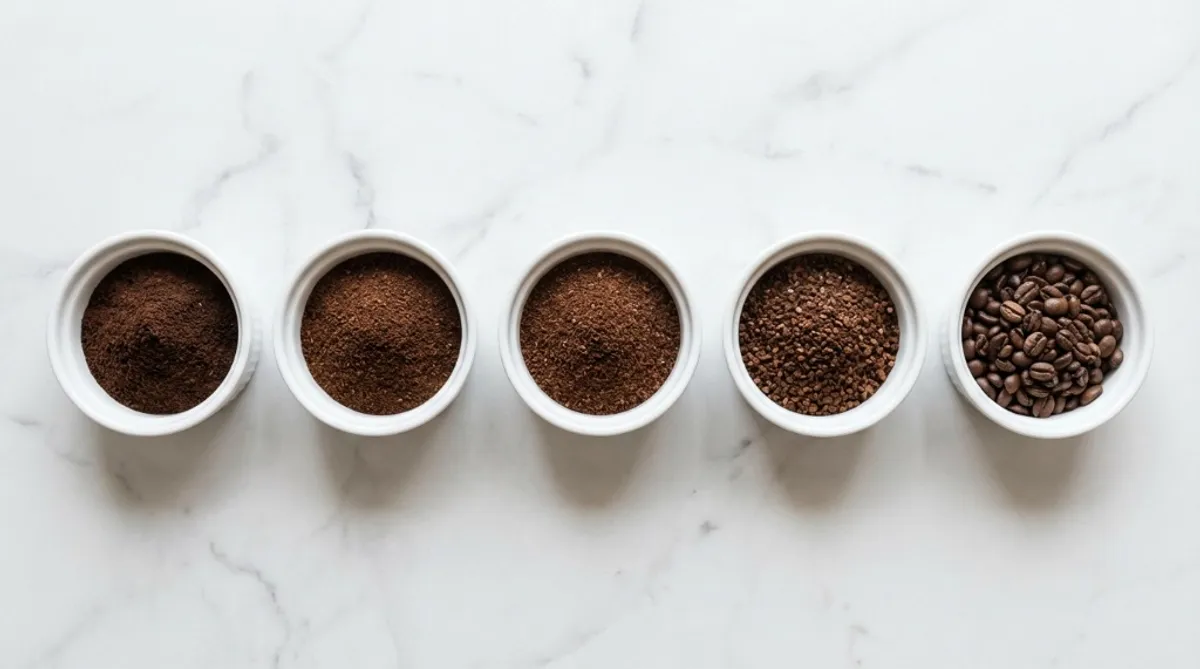
Every new bag of coffee means 2-3 shots down the drain before things taste right. That’s just how espresso works. What was perfect for your last beans might be completely wrong for these.
After going through dozens of different origins and roasts on my Barista Express, I’ve developed a mental framework for predicting where my grind should start before I even pull the first shot. Saves beans, time, and that annoying feeling of wasting good coffee. Here’s what I’ve learned.
Why Grind Size Matters So Much
Grind size is the single most important variable you control. Not dose, not tamp, not water temperature. Grind.
Grind controls how fast water flows through. Finer grounds pack tighter, creating more resistance. Water takes longer to pass through, extracting more. Coarser grounds let water rush through, extracting less.
Think of it like traffic:
- Fine grind = narrow road → slow traffic → more extraction time
- Coarse grind = highway → fast traffic → less extraction time
The goal is finding the grind that produces 25-30 second extraction for a balanced shot. Here’s the catch though: what worked yesterday might be wrong today.
The Factors That Affect Your Grind Setting
1. Roast Level
Roast level matters more than anything else for dialing in.
| Roast Level | Bean Characteristics | Grind Adjustment |
|---|---|---|
| Light | Dense, hard, high acidity | Finer (need more extraction) |
| Medium | Balanced density | Standard setting |
| Dark | Porous, oily, low acidity | Coarser (extracts quickly) |
Why this happens:
- Light roasts spend less time in the roaster, so the bean stays dense and hard. Water has trouble penetrating, so you need finer grinds and longer extraction.
- Dark roasts roast longer, breaking down cell structures. They’re porous and give up their solubles easily—sometimes too easily.
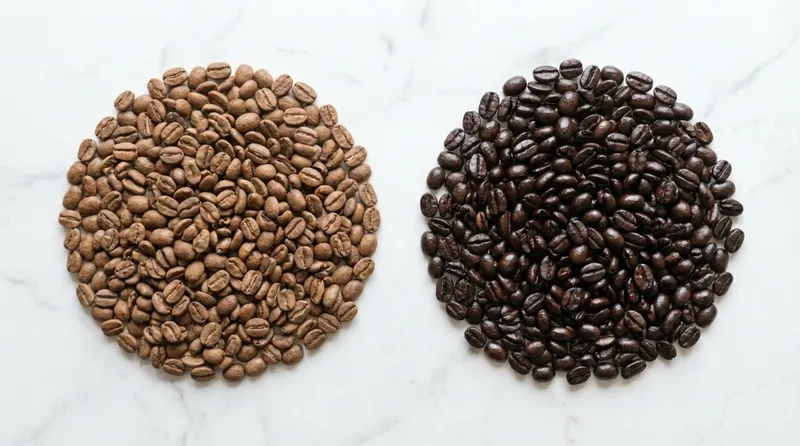
My Breville starting points:
- Light roast: Setting 3-4
- Medium roast: Setting 5-6
- Dark roast: Setting 7-8
2. Bean Origin
Where beans come from affects how they grind:
| Origin Region | Typical Characteristics | Grind Tendency |
|---|---|---|
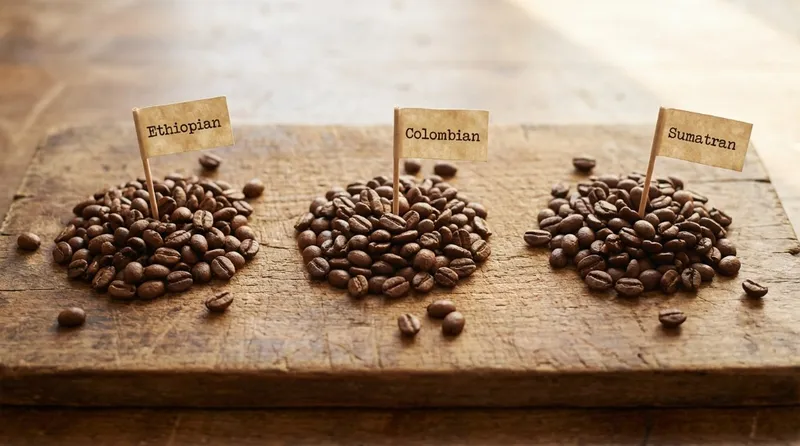
| African (Ethiopian, Kenyan) | High altitude, dense, fruity | Finer |
| Central American (Colombian, Guatemalan) | Medium density, balanced | Standard |
| Indonesian (Sumatra, Java) | Low altitude, earthy | Slightly coarser |
The altitude connection: Beans grown at high altitudes (African, some Central American) are denser—they develop more slowly in cooler mountain temperatures. Dense beans need finer grinds.
I consistently find Ethiopian naturals need 1-2 steps finer than Colombian washed at the same roast level. It’s predictable once you know.
3. Bean Freshness
Fresh beans behave completely differently from older beans:
| Freshness | Behavior | Grind Adjustment |
|---|---|---|
| 3-7 days post-roast | High CO2, chaotic extraction | Start coarser |
| 7-21 days post-roast | Optimal window, stable | Standard setting |
| 21-30 days | Losing volatiles, flatter crema | Slightly finer |
| 30+ days | Stale, hard to extract sweetness | Finer, but results diminish |
The CO2 effect: Fresh beans are still degassing CO2 like crazy. That gas creates resistance during extraction, making shots run slower. As beans age and degas, you need to grind finer to maintain timing.
I’ve seen brand-new beans (3 days post-roast) need 2 full steps coarser than that same bag at 14 days. That’s a huge difference.
4. Processing Method
How the coffee was processed at origin also matters:
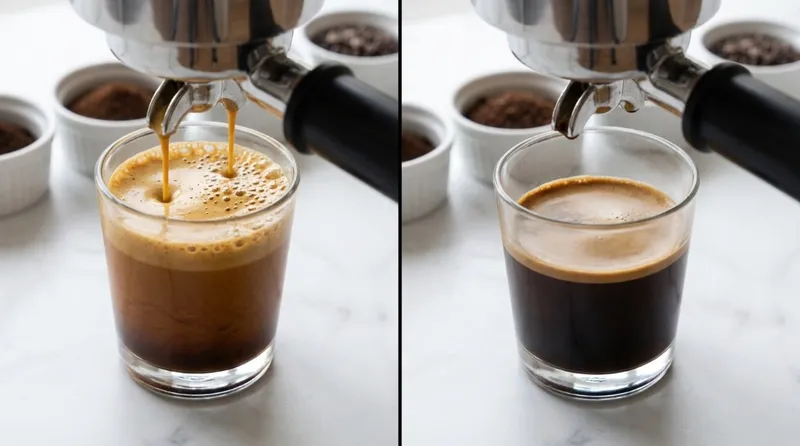
- Washed/wet process: Clean, consistent → Standard grind
- Natural/dry process: More oils, complex → Often slightly finer
- Honey process: In between → Test and adjust
Natural processed beans have more residual fruit material, affecting extraction. I typically go 1 step finer with naturals.
Practical Grind Adjustment on Breville
The Breville Grinder Dial
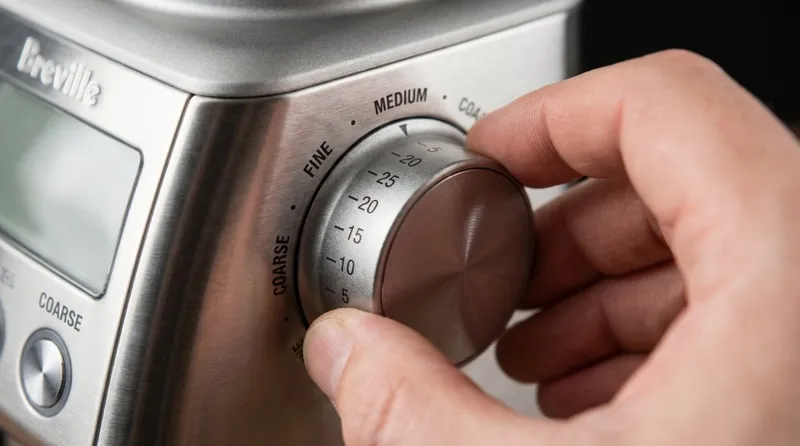
The Barista Express and Smart Grinder Pro use a numbered dial:
- Lower numbers (1-5) = Finer
- Higher numbers (11-16) = Coarser
- Espresso sweet spot: 3-8 for most beans
Critical rule: Only adjust the dial while the grinder is actually running. Adjusting when static can damage your burrs. I almost made this mistake before reading the manual carefully.
Starting Point Chart
Use this as your initial setting, then adjust based on timing:
| Bean Type | Grind Setting | Expected Adjustment |
|---|---|---|
| Light roast African | 3-4 | ±1 by taste |
| Light roast Central American | 4-5 | ±1 by taste |
| Medium roast (any origin) | 5-6 | ±1 by taste |
| Dark roast | 7-8 | ±1 by taste |
| Very oily dark roast | 8-9 | Watch for clogs |
| Decaf | +1-2 coarser than regular | Decaf extracts faster |
My Step-by-Step Dial-In Process
When I open a new bag:
Shot 1: The Scout
- Start at predicted setting based on roast/origin
- Pull a shot, time it
- Note timing and taste—don’t adjust yet, just observe
Shot 2: The Adjustment
- If Shot 1 was fast (under 22 sec), go 1-2 steps finer
- If Shot 1 was slow (over 35 sec), go 1-2 steps coarser
- Pull another shot
Shot 3: The Refinement
- Smaller adjustments now (half steps if possible)
- Taste for balance—timing is a guide, not the goal
- Usually dialed in by now
After dial-in: Write down the setting somewhere. When you buy that same coffee again, you’ll know exactly where to start.
Troubleshooting Common Grind Issues
Problem: Sour and Thin (Under-Extracted)
Symptoms:
- Shot finishes under 20 seconds
- Sharp, acidic taste
- Watery, thin body
Causes:
- Grind too coarse
- Not enough coffee
- Beans too fresh (high CO2)
What to do:
- Grind 1-2 steps finer
- Increase dose by 0.5-1g
- If beans are super fresh, wait a few more days to use them
Problem: Bitter and Harsh (Over-Extracted)
Symptoms:
- Shot takes over 35 seconds
- Bitter, ashy taste
- Dry, chalky mouthfeel
Causes:
- Grind too fine
- Too much coffee
- Stale beans
- Dirty equipment
What to do:
- Grind 1-2 steps coarser
- Reduce dose by 0.5-1g
- Clean your machine (backflush, shower screen)
- Check bean freshness
Problem: Inconsistent Shots
Symptoms:
- Same settings, wildly different timing
- Channeling visible
- Some good, some terrible
Causes:
- Uneven distribution in basket
- Inconsistent tamping
- Grinder retention mixing old grounds with new
- Variable bean quality
What to do:
- Use WDT (Weiss Distribution Technique)—stir grounds with needles
- Practice consistent tamping
- Purge 1-2g after adjusting grind
- Buy specialty-grade beans
Problem: Grinder Clogging
Symptoms:
- Grounds not coming out
- Motor sounds strained
- Clumpy output
Causes:
- Very oily dark roast
- Static buildup
- Humid conditions
- Built-up residue
What to do:
- Go 2-3 steps coarser for oily beans
- Clean burrs monthly
- Add a drop of water to beans before grinding (RDT technique)
- Don’t leave beans in hopper more than a week
Advanced: Fine-Tuning Beyond Grind Size
Once you’ve nailed grind, here are other variables to play with:
Dose Adjustments
For the same grind setting, changing dose affects extraction:
- Higher dose = More resistance = Slower shot
- Lower dose = Less resistance = Faster shot
Common workaround when you’re stuck between grind settings: keep grind constant, adjust dose by ±1g.
Temperature (Dual Boiler and higher-end machines)
If you can adjust temperature:
- Lower temp (91-93°C): Better for dark roasts, reduces bitterness
- Higher temp (94-96°C): Better for light roasts, increases extraction
Barista Express doesn’t have temp control, but you can influence it:
- Flush before brewing for hotter shots
- Wait after steaming for cooler shots
Pre-Infusion
Longer pre-infusion helps with:
- Light roasts (more time for water to penetrate dense beans)
- Reducing channeling (gentler initial saturation)
Some Breville machines have programmable pre-infusion. Try 3-6 seconds for light roasts.
Creating Your Own Grind Log
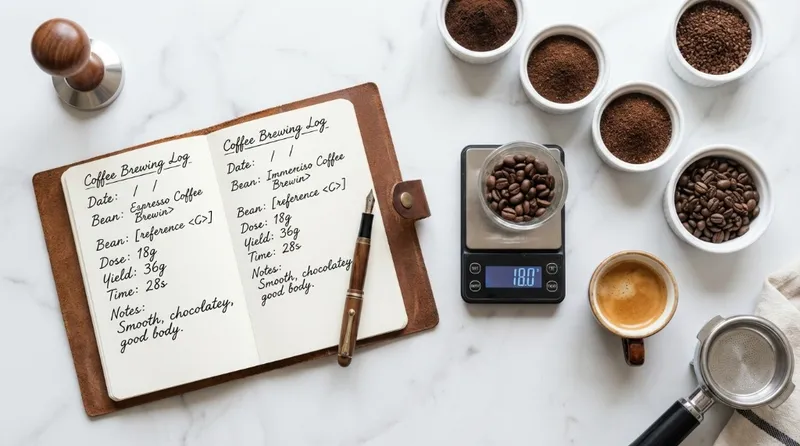
I highly recommend keeping notes. Simple format:
Bean: [Name, Roaster]
Roast Level: [Light/Medium/Dark]
Origin: [Country]
Roast Date: [Date]

Day 1 (7 days post-roast):
- Grind: 5
- Dose: 18g
- Time: 28 sec
- Taste: Balanced, slight brightness
- Notes: Good starting point

Day 7 (14 days post-roast):
- Grind: 4 (adjusted finer)
- Dose: 18g
- Time: 27 sec
- Taste: Sweet, full body
- Notes: Perfect dial-in
After logging a few bags, you’ll start seeing patterns. Ethiopian beans? Start at 4. Dark Colombian? Start at 7. This knowledge compounds.
FAQ
How often should I adjust grind for the same bag?
Dial in once when you open the bag, then probably adjust again around day 14-16 as beans degas. After that, minor tweaks every few days.
Can I use the same grind for espresso and other methods?
Nope. Espresso needs much finer grind than pour-over or French press. If you use your Breville grinder for multiple methods, you’ll need big adjustments between them.
Why do my shots taste different in the morning vs evening?
Machine temperature fluctuates. Morning shots may run cooler—especially that first shot of the day. By evening, machine is fully stabilized. Always flush before your first shot.
My grind setting keeps drifting. Is my grinder broken?
Probably not. Burrs wear over time, gradually requiring finer settings for the same result. This is slow—months or years. Sudden drift usually means humidity changes, different beans mixed in, or inconsistent technique.
Should I adjust grind or dose first?
Grind first. It’s the more powerful variable. Only adjust dose when you’re stuck between grind settings or want small tweaks.
Conclusion
Mastering grind adjustment is the single biggest skill for espresso success:
- Roast level matters most: Light = finer, Dark = coarser
- Freshness changes things: New beans = coarser, aging beans = finer
- Origin gives clues: High-altitude = finer, low-altitude = coarser
- Always time your shots: 25-30 seconds is your target
- Keep a log: Your notes become your best resource
Every new bag is a puzzle. But the more you practice, the faster you solve it. Start with the charts above, pay attention to timing, trust your taste. Within a dozen bags, you’ll be dialing in like you’ve been doing this for years.
Happy grinding!
Mikael
Home espresso enthusiast and Breville specialist. Helping you master the art of coffee brewing from your own kitchen.
Learn more about me →