Heart Latte Art Tutorial: Beginner's First Pattern
Step-by-step guide to pouring your first heart latte art on a Breville espresso machine. Master milk texture, positioning, and flow.

The heart is where every latte artist starts—and where many give up. I poured probably 50 terrible “blobs” before my first recognizable heart appeared. But once you understand what’s actually happening in the cup, it clicks.
Here’s everything I wish someone had told me when I first tried latte art on my Breville Barista Express.
Why Start With the Heart?
The heart is the foundation of all latte art patterns:
| Pattern | Difficulty | Based On |
|---|---|---|
| Heart | ⭐ Beginner | Direct pour |
| Monk’s Head | ⭐ Beginner | Heart + no pull |
| Tulip | ⭐⭐ Intermediate | Stacked hearts |
| Rosetta | ⭐⭐⭐ Advanced | Heart + wiggle |
| Swan | ⭐⭐⭐⭐ Expert | Multiple techniques |
Master the heart first. Every other pattern builds on the same principles: where to pour, how fast, and when to pull through.
Before You Pour: Prerequisites
Milk Quality Requirements
| Factor | Requirement | Why |
|---|---|---|
| Texture | Microfoam (wet paint consistency) | Too thick = no flow, too thin = no contrast |
| Temperature | 55-65°C (130-150°F) | Above 70°C destroys proteins |
| Bubbles | ZERO visible bubbles | Bubbles break your pattern |
If your steamed milk looks like bubble bath, stop here. Practice milk stretching until you consistently get glossy, tight microfoam.
Espresso Requirements
- Fresh shot (under 30 seconds old)
- Good crema coverage
- Not too light/thin—dark crema holds contrast better
- Cup should be about 1/3 full
Cup Size
Start with 8-12 oz cups. Larger cups are easier—more surface area, more time to work. Don’t learn in a tiny 3 oz espresso cup.
The Basic Heart Pour
Step 1: Start High

Hold your pitcher about 6 inches above the cup surface.
Why: High pour = slow pour = milk sinks below crema
At this height, pour steadily into the center of the cup. You’re filling volume, not creating art yet.
Fill to: About 60% full
Step 2: Drop and Slow

When the cup is 60% full, bring your pitcher down to almost touching the surface—about 1/2 inch away.
Simultaneously:
- Lower the pitcher
- Slow your pour
- Keep pouring into the center
What happens: Milk starts floating ON the crema instead of sinking under it.
Step 3: The Heart Forms

When you see white appearing on the surface—this is your heart forming!
Keep pouring in the same spot. The white circle expands outward. This becomes the body of your heart.
Duration: 2-3 seconds of sustained pour
Step 4: The Pull-Through

This is where beginners mess up most.
When your heart is the size you want:
- Raise the pitcher slightly (2-3 inches)
- Move forward in a straight line through the center of the white circle
- Keep pouring a thin stream as you move
- End at the far edge of the cup
The pull-through creates the point of the heart and defines its shape.
Step 5: Cut
When you reach the edge, simply stop pouring and lift away.
Visual Guide: What to Watch For
During High Pour (Step 1)
- All brown surface—milk is sinking
- Crema might swirl slightly
- No white should appear yet
During Low Pour (Steps 2-3)
- White starts appearing in center
- Circle expands evenly outward
- Surface stays relatively flat
During Pull-Through (Step 4)
- White circle gets a “tail”
- Movement creates the heart point
- Line should be relatively straight
The Most Common Mistakes
Mistake 1: Pouring Too Fast
What happens: Milk blasts through crema, creates holes and mess The fix: Slow, controlled pour. Think “thick honey” not “watering plants”
Mistake 2: Staying High Too Long
What happens: Cup fills but no white appears—you’ve buried all your microfoam under crema The fix: Drop earlier. By 50-60% full you should be low
Mistake 3: Not Getting Low Enough
What happens: Milk keeps sinking even when your cup is full The fix: Pitcher spout should almost kiss the surface. If you’re worried about touching, you’re still too high.
Mistake 4: Stopping Before Pull-Through
What happens: You get a white blob, not a heart The fix: The pull-through IS the heart shape. Without it, you just have a circle.
Mistake 5: Moving Sideways Instead of Forward
What happens: Weird stretched shape, not a heart The fix: Push straight through the center of your white circle, don’t curve
Mistake 6: Bad Milk
What happens: Everything “right” but still no pattern The fix: Back to fundamentals. Your milk must be true microfoam—glossy, no visible bubbles, pourable like wet paint.
Practice Routine
Week 1: Just Pour High-to-Low
Forget the heart shape. Just practice:
- Start high
- Drop to surface when 50% full
- See white appear
Don’t worry about pull-through yet. Get comfortable with the transition.
Week 2: Add the Pull-Through
Once you can consistently get white to appear:
- Pour until white circle forms
- Practice the forward movement
- Try to create ANY point at the end
Hearts will probably look terrible. That’s fine.
Week 3: Refine Timing
Focus on:
- When exactly to start dropping
- How long to pour at surface level
- Speed of pull-through
Week 4: Consistency
By now you should have occasional recognizable hearts. Work on:
- Centering the heart
- Consistent size
- Symmetry
How to Practice Without Wasting Coffee
Use Water + Dish Soap
- Fill pitcher with water
- Add 1-2 drops of dish soap
- Use steam wand to froth (soap creates foam)
- Practice pouring into a cup of cold water with brown food dye
Not perfect, but gets you hundreds of practice pours without buying milk.
Save Failed Lattes
Even ugly latte art tastes fine. Drink your practice attempts. Or give them to friends who care more about caffeine than aesthetics.
Make Multiple Drinks
If you have someone to drink them, batch your practice. Make 3-4 lattes in a row. By the third one, you’re warmed up and more relaxed.
Breville-Specific Tips
Steam Wand Positioning
The Breville steam wand is shorter than commercial machines. You’ll probably need to:
- Tilt the pitcher more steeply
- Create your vortex slightly differently
- Work faster as milk heats quickly
Pour Immediately After Steaming
Breville microfoam breaks down faster than some machines. Pour within 30 seconds of finishing your steam.
Practice Without Espresso
Use old coffee or hot water with brown food coloring. This lets you practice the pour without wasting good shots.
What Good vs Bad Looks Like
Bad Heart Pours
| Result | Likely Cause |
|---|---|
| Brown cup, no white | Never got low enough |
| White blob, no point | No pull-through |
| Streak across cup | Moved sideways not forward |
| Hole in center | Poured too hard/fast |
| White sunk to bottom | Milk not steamed properly |
Good Heart
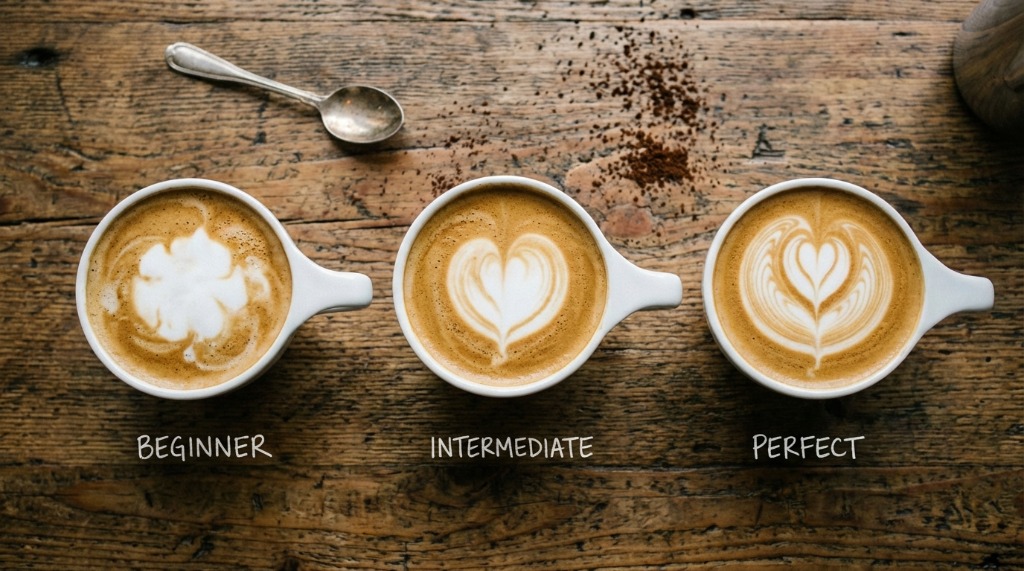
- Clear white shape on brown background
- Defined point at one end
- Rounded lobes at other end
- Mostly centered in cup
- Clean edges
FAQs
How long until I can pour a heart?
Most people see recognizable hearts within 2-4 weeks of daily practice (one drink per day). Some click faster, some take longer.
Does cup shape matter?
Yes. Wide, rounded cups are easier. V-shaped or straight-walled cups are harder. Start with a classic latte cup shape.
My heart always goes to one side. Why?
You’re probably:
- Not centered when you start
- Moving off-center during pour
- Pulling through at an angle
Try marking the center of your cup and aiming there.
Why does my heart have no point?
Your pull-through isn’t long enough or you’re:
- Lifting too high (stream breaks)
- Moving too slow (stream puddles)
- Not moving at all (no pull-through)
Can I do latte art with oat milk?
Yes, with practice. Oat milk textures slightly differently and can be more “slidey.” Many baristas prefer Oatly Barista Edition. Check our oat milk guide.
Key Takeaways
- The heart is your foundation—master it before moving on
- High pour → low pour → pull through—three phases to remember
- Microfoam quality matters most—bad milk = no art
- Get LOW—pitcher should nearly touch surface
- The pull-through creates the point—don’t skip it
- Practice takes time—expect weeks, not days
Once the heart clicks, you’ll be amazed how quickly you progress to other patterns. From here, adding a wiggle gives you a rosetta, stacking multiple pours gives you tulips. It all starts with a simple heart.
Related Guides:

Mikael
Home espresso enthusiast and Breville specialist. Helping you master the art of coffee brewing from your own kitchen.
Learn more about me →