Breville Descaling Guide: Vinegar vs Solution
Complete Breville descaling guide comparing vinegar, solution, and powder methods. Step-by-step instructions, frequency tips, and troubleshooting.
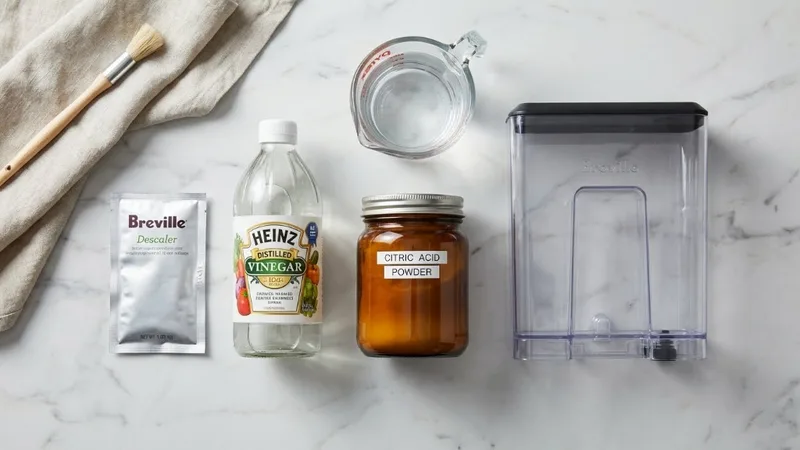
Pulled a shot last week and it tasted… off. Metallic, almost. Checked my beans—fresh. Checked my grind—dialed in. Then I remembered: I hadn’t descaled in almost four months. Oops.
If you’re running a Breville espresso machine and wondering why your shots are tasting weird or your steam pressure feels weak, scale buildup is probably the culprit. Those mineral deposits from your tap water slowly clog everything inside—the boiler, tubes, valves. Not fun.
This Breville descaling guide covers everything I’ve figured out through trial and error: why you can’t skip this, what warning signs to watch for, a real comparison between vinegar, Breville’s official solution, and citric acid powder, plus the full step-by-step process. Let’s get into it.
Why Descaling is Essential
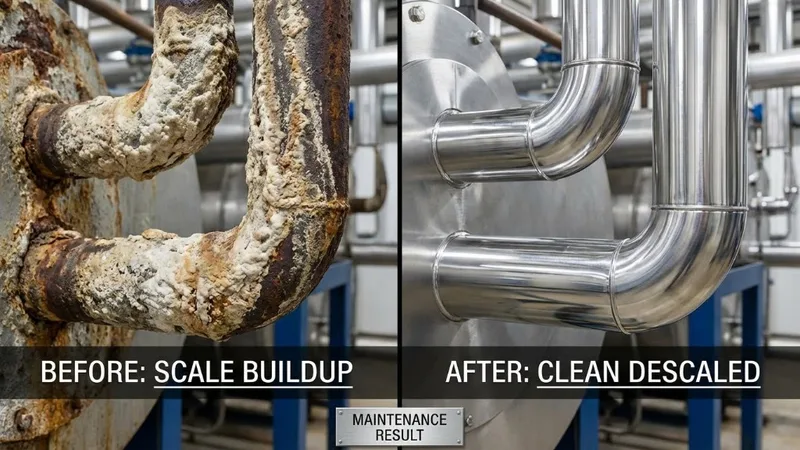
Here’s what’s actually happening inside your machine: limescale—basically hardite mineral crud from calcium and magnesium in water—builds up everywhere. The boiler, the thermocoil, the tubes, the valves. After a few months of daily use, you’ve got problems.
What scale actually does to your machine:
- Chokes water flow through the heating system
- Messes with temperature—your thermocoil can’t heat evenly with gunk coating it
- Makes espresso taste weird—bitter, metallic, just… not right
- Eventually breaks stuff—and repairs aren’t cheap
I ignored descaling for about six months once. Steam pressure dropped to almost nothing, shots ran slow, and the whole machine sounded unhappy. Learned my lesson the expensive way when I had to replace a gasket that got damaged from the heat buildup.
For Barista Express, Bambino Plus, Oracle—basically any Breville—the manufacturer explicitly says to descale regularly. And they’re not just trying to sell you solution packets. This actually matters.
Neglect it long enough and you’re looking at $100+ for a new boiler. In hard water areas, scale forms fast. Really fast. Daily users in places like Arizona or parts of Texas? You need to be on top of this.
Think of it like brushing your teeth. Skip it for a few days, probably fine. Skip it for months? Problems.
Signs Your Machine Needs Descaling
The machine will tell you when it’s time—sometimes literally with a light, sometimes through subtle hints you might miss if you’re not paying attention.
Visual Indicators
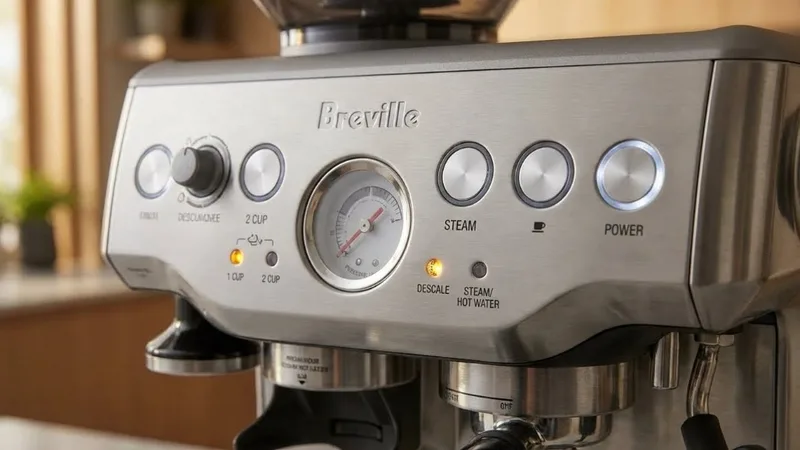
- CLEAN/DESCALE light glowing solid—can’t really miss this one
- Buttons flashing weirdly—power or program buttons blinking at you
- On-screen message—Oracle and Touch models spell it out
Performance Signs
These showed up for me before any light came on:
- Espresso flowing slower than usual—what normally takes 28 seconds now takes 40
- Steam wand feels pathetic—barely enough pressure to stretch milk properly
- Temperature dropping—shots coming out lukewarm when the machine should be fully heated
- Weird gurgling or knocking sounds—my machine started making noises I’d never heard before
- Pressure gauge acting erratic—jumping around during extraction instead of holding steady
Taste Changes
This is what finally got my attention:
- Bitter, metallic notes—even with beans I know taste great
- Flat, boring shots—missing that complexity and sweetness
- Chalky aftertaste—lingers unpleasantly
If you’re noticing a few of these together, descale now. Don’t wait for the light.
Descaling Methods Compared
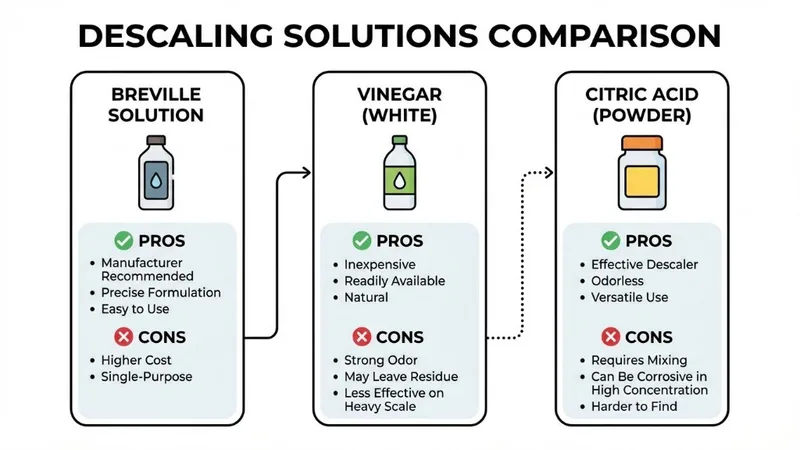
So you’ve got three main options here. I’ve tried all of them, and honestly they all work. The question is what trade-offs you’re willing to make.
Method 1: Breville Descaling Solution
What It Is: The official stuff—pre-mixed liquid or powder sachets made specifically for Breville machines.
Pros:
- ✅ Formulated specifically for Breville’s aluminum thermocoil (won’t damage it)
- ✅ Pre-measured—no guessing
- ✅ Just dump it in and go
- ✅ Keeps your warranty intact
- ✅ Rinses out cleanly
Cons:
- ❌ Pricey—$12-20 every time you descale
- ❌ Have to order it or find it in stores
- ❌ Sometimes out of stock when you need it
Ratio: 1 sachet per 1 liter of water (just follow the packet)
Method 2: White Vinegar
What It Is: Regular distilled white vinegar from the grocery store. 5% acetic acid.
Pros:
- ✅ Cheap—like pennies per descale
- ✅ Available literally anywhere
- ✅ Works well on calcium deposits
- ✅ Food-safe, obviously
Cons:
- ❌ Smells absolutely terrible (ask my wife)
- ❌ Breville says don’t use it—though plenty of people do
- ❌ Need extra rinse cycles to get rid of the smell
- ❌ Might affect rubber seals over time
- ❌ Some people taste it for days after
Ratio: 1:1—half vinegar, half water
Heads up: If you go the vinegar route, rinse at least 3-4 times with fresh water. Maybe more. That smell gets into everything.
Method 3: Citric Acid Powder
What It Is: Food-grade citric acid powder. You can find it in grocery stores with the canning supplies or order online.
Pros:
- ✅ Destroys scale effectively—some people say better than the official stuff
- ✅ Super cheap—one bag lasts years
- ✅ No smell at all
- ✅ What a lot of coffee pros actually use
- ✅ Rinses clean
Cons:
- ❌ You have to measure it out
- ❌ Not officially approved by Breville
- ❌ Slightly more aggressive than their solution
Ratio: 8-12g (roughly 1-2 tablespoons) per 1 liter of water
I’ve been using citric acid for the past year. Bought a bag on Amazon for $8 and I’m still working through it. Works great.
Comparison Table
| Feature | Breville Solution | White Vinegar | Citric Acid Powder |
|---|---|---|---|
| Cost per Use | $12-20 | <$1 | $1-2 |
| Effectiveness | ★★★★★ | ★★★☆☆ | ★★★★★ |
| Ease of Use | ★★★★★ | ★★★☆☆ | ★★★★☆ |
| Smell | None | Strong | None |
| Rinse Cycles Needed | 2 | 3-4 | 2 |
| Breville Approved | ✅ Yes | ❌ No | ❌ No |
| Best For | All users | Budget option | Heavy scale |
Our Recommendation
Real talk based on what I’ve actually used:
- Most people: Breville Solution is the safest bet, zero hassle
- Heavy scale buildup: Citric acid powder—it’s aggressive and cheap
- Tight budget: Diluted vinegar works, just rinse the heck out of it
- Worried about warranty: Stick with Breville’s official stuff
Step-by-Step Descaling Process
Alright, let’s actually do this. Set aside about 45 minutes to an hour—it’s not complicated, just takes time with the soaking and rinsing.
Preparation
Before anything else:
- Dump out the water tank—completely empty
- Pull out that water filter—descaling solution will destroy it
- Clear out any coffee—nothing in the portafilter or grinder
- Grab a big container—at least 2L capacity, position it under the group head and steam wand
Step 1: Mix Your Solution
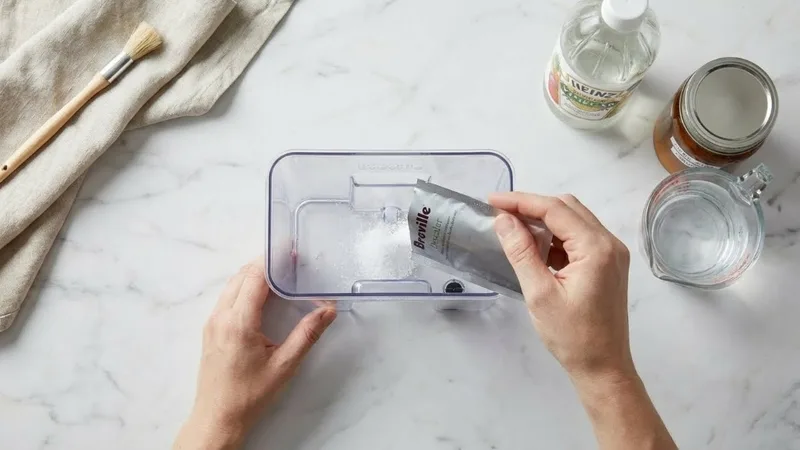
Pick your weapon and prepare it:
| Method | Mixture |
|---|---|
| Breville Solution | 1 sachet + 1L water |
| Vinegar | 500ml vinegar + 500ml water |
| Citric Acid | 10g powder + 1L water |
If you’re using powder, stir until it’s completely dissolved. Nobody wants citric acid granules gunking up their valves.
Step 2: Fill the Tank
- Pour your solution into the empty water tank
- Top up with plain water if needed to hit the MAX line
- Seat the tank back in place (remember—no filter!)
Step 3: Enter Descale Mode
This varies by model, which confused me the first time. Here’s what works:
Barista Express / Pro:
- Power off the machine
- Hold down 1-CUP + 2-CUP + POWER all at once
- Keep holding for 3-5 seconds until the lights start flashing
- You’re in descale mode
Bambino / Bambino Plus:
- Turn off the machine
- Hold 1-CUP while you turn it back on
- Steam light flashing = you’re in
Oracle / Oracle Touch:
- Go to Settings → Maintenance → Descale
- Follow whatever it tells you (these machines basically walk you through it)
Step 4: Run Solution Through Group Head
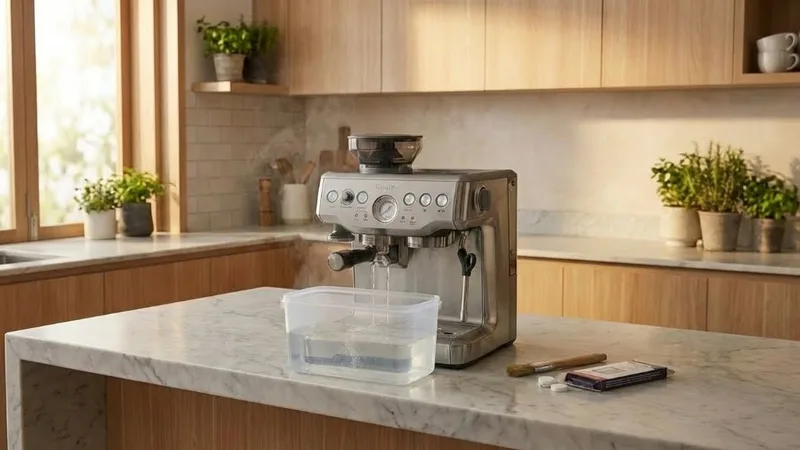
- Lock an empty portafilter into the group head
- Put your container underneath
- Hit 2-CUP (or your model’s equivalent)
- Let about 1/3 of the tank run through
- Now stop and let it soak for 15-20 minutes—this is critical, don’t skip it
That soak time lets the solution actually dissolve the scale. I rushed this once and had to descale again the following week. Not worth it.
Step 5: Run Solution Through Steam Wand
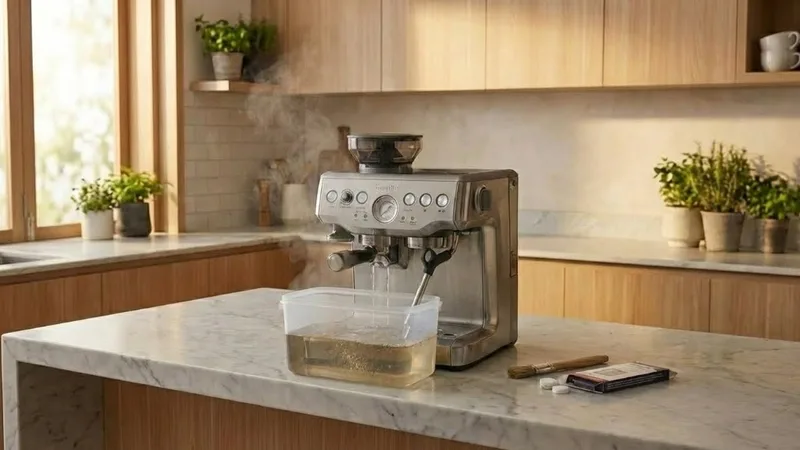
- Point the steam wand into your container
- Open the steam valve
- Let solution flow for 30-60 seconds
- Close it off
- Another 10 minute soak—let it work on the scale in there
Step 6: Complete the Cycle
- Run the rest of the solution through the group head
- Alternate between group head and steam wand
- Keep going until the tank is empty
Step 7: Rinse Thoroughly (Critical!)
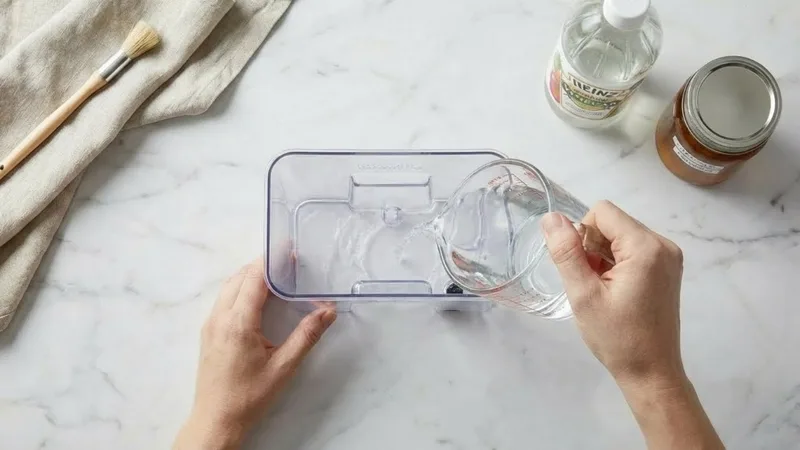
This is where most people mess up. Don’t rush the rinse.
- Dump out any remaining solution
- Fill up with fresh, clean water to MAX
- Run the whole tank through the group head
- Refill and run through the steam wand
- Repeat 2-3 times minimum
If you used vinegar: I’d do 3-4 full rinse cycles. That smell is persistent. Trust me on this one.
Step 8: Exit Descale Mode
- Turn the machine off
- Turn it back on normally
- Descale light should be off now
- Put your water filter back in
Step 9: Test
- Pull a shot—dump it, don’t drink it
- Steam some water through the wand
- Check for any weird taste or smell
- Still off? Run another rinse cycle
I always pull two “throwaway” shots after descaling just to be safe. Small price to pay.
How Often Should You Descale?
Depends on your water and how much coffee you make. Here’s a rough guide:
| Water Hardness | Usage Level | Descale Frequency |
|---|---|---|
| Soft (Level 1) | Light | Every 4-6 months |
| Soft (Level 1) | Heavy | Every 2-3 months |
| Moderate (Level 2) | Light | Every 2-3 months |
| Moderate (Level 2) | Heavy | Every 6-8 weeks |
| Hard (Level 3-4) | Light | Every 6-8 weeks |
| Hard (Level 3-4) | Heavy | Every 3-4 weeks |
Red flags that you should descale more often:
- Descale light keeps triggering early
- Performance drops between your scheduled descales
- You live somewhere with notoriously hard water
I keep a note in my phone with descale dates. Old school? Maybe. But it works better than trying to remember.
Troubleshooting After Descaling
Problem: Machine Won’t Exit Descale Mode
This happened to me once and I panicked. Turns out it’s usually simple:
Solutions:
- Make sure you actually ran enough water through (full tank at minimum)
- Power cycle—off for 30 seconds, then back on
- Double-check your specific model’s exit procedure
- Some models need you to hold certain buttons to reset
Problem: Residual Taste or Smell
The vinegar curse. Or just incomplete rinsing.
Solutions:
- Run 2-3 more full tank rinses
- Pull several shots and dump them
- Steam water through the wand multiple times
- Sometimes letting it sit overnight and rinsing again in the morning helps
Problem: Performance Still Poor After Descaling
Could mean the scale was really bad.
Solutions:
- Run a second complete descale cycle
- Check for other issues—maybe gaskets or filters need attention
- Really severe cases might need professional service
- Going forward, descale more frequently
Problem: Descale Light Comes Back Quickly
Annoying, but usually means your settings are wrong.
Solutions:
- Check your water hardness setting—might be programmed too low
- Your water might be harder than you thought—descale more often
- Make sure the water filter is actually installed and not overdue for replacement
- Consider switching to filtered or bottled water
Prevention Tips
Way easier to prevent scale than to fight it. Here’s what actually helps:
- Use and replace water filters—every 2-3 months, don’t push it
- Filter your water first if you’ve got really hard water
- Test your water hardness once a year—it can change with seasons or if your city changes sources
- Program the correct hardness level into your machine
- Stick to the schedule even when shots seem fine
- Empty the tank if you’re not using the machine for a week or more
- Write down when you descale—I can’t stress this enough
FAQs
Can I use vinegar in my Breville machine?
Technically yes, and plenty of people do it without issues. Use a 1:1 mix with water and rinse really thoroughly—3-4 cycles minimum. It’s not officially recommended, so you’re on your own if something goes wrong. Main concerns: lingering smell and possible seal damage if you do it too often.
Which is better: citric acid or Breville solution?
For heavy scale, citric acid wins—it’s more aggressive and way cheaper. Breville’s solution is more convenient and keeps your warranty safe. For regular maintenance either works fine. If your machine is really gunked up, I’d reach for citric acid.
How long does the descaling process take?
Block out about an hour total. The descale itself is 30-45 minutes, then another 20-30 for rinsing. Those soak periods matter—don’t try to speed through them or you’ll end up doing it again.
Is the descaling solution safe for the milk system?
On machines with integrated milk systems like the Oracle—no, keep descaling solution away from the milk frother. Stick to the water/espresso path only. Clean the milk system separately according to your manual.
What if my machine doesn’t have a descale light?
Go by schedule instead. Every 4-8 weeks depending on water hardness and usage. Watch for the performance signs—slow flow, weak steam. Better to descale proactively than wait until things go wrong.
Key Takeaways
- Don’t wait for problems—when that light comes on or steam gets weak, descale immediately
- Pick your method: Breville solution (easy and safe), citric acid (cheap and effective), vinegar (budget option but smelly)
- Remember your ratios: 1 sachet of Breville, 1:1 for vinegar, 10g citric acid per liter
- The soak time matters—15-20 minutes is when the solution actually does its work
- Rinse generously—2-4 tank fulls depending on what you used
- Schedule it: Every 4-8 weeks for hard water, 2-3 months for soft water areas
- Prevention beats treatment—water filters and filtered water save you hassle
I know descaling feels like a chore, but spending an hour on it every couple months beats the alternative. My machine’s been running strong for three years now with consistent maintenance. Your espresso will taste better, your steam will be stronger, and you’ll avoid expensive repairs down the road.
Related Guides:

Mikael
Home espresso enthusiast and Breville specialist. Helping you master the art of coffee brewing from your own kitchen.
Learn more about me →